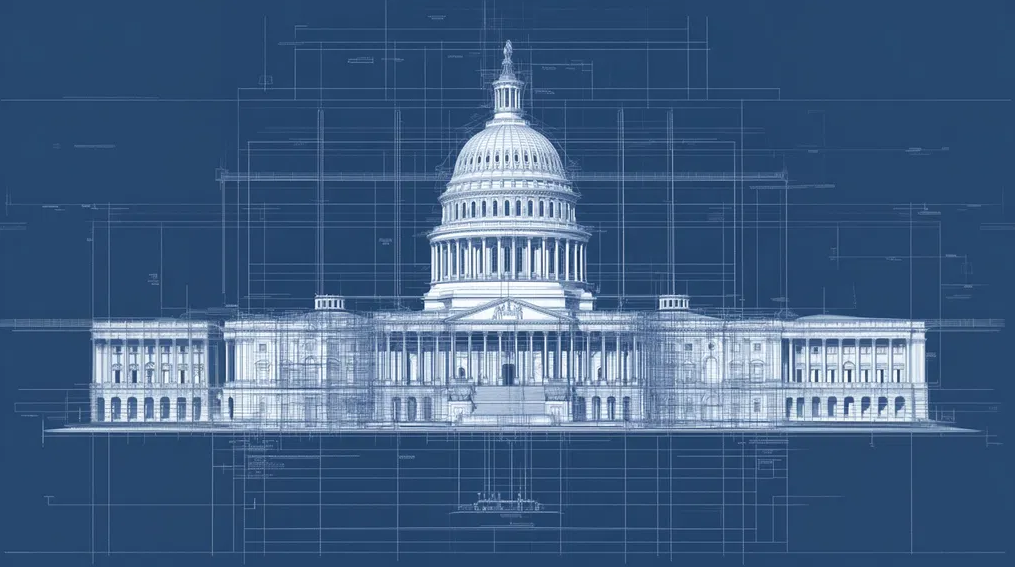
At the Center for Self Governance, we often speak of the American Nation-state Republic as a complex and finely tuned machine. Just as an aircraft mechanic must understand the cockpit controls and structural integrity before the plane can safely take flight, a citizen must understand the jurisdictional boundaries and operational controls that define our constitutional system. Without this foundational understanding, participation in self governance is often reduced to reactive emotionalism or partisan politics. With it, you become a vital part of the maintenance crew, a systematic practitioner who keeps the machinery of government running as it was designed.
In this introductory guide, we will explore the blueprints of our “eight-boundary Nation-state republic,” the critical differences between “Layer Cake” and “Marble Cake” federalism, and how you can begin mastering the local system through the practice of systematic politics.
Defining the Blueprint: What Are Jurisdictional Boundaries?
In the study of systematic politics, a “jurisdiction” is not merely a geographic area on a map; it is a defined boundary of authority. It answers the fundamental question: Who has the legal right to act in this specific matter within this area?
Our constitutional design is built upon dual federalism, a system where the boundaries and controls are divided or shared between different levels of government. When these boundaries are clearly defined, the system remains stable. However, when these boundaries are ignored or blurred, the system begins to malfunction.
Understanding these boundaries is the core objective of our School of Societal Self Governance. We teach students to look past the “partisan issues” of the day and instead analyze and troubleshoot the Power, System, and Control at play. By identifying which jurisdiction, school, city, county, region, state, or federal, has the proper authority over a specific situation, you can engage the system with surgical precision rather than blunt force.
The Structural Shift: Layer Cake vs. Marble Cake Federalism
To understand why the modern political landscape feels so chaotic, we must examine a profound shift in how our government’s layers interact.

Layer Cake Federalism (Dual Federalism)
Historically, the United States operated under what political scientists call Layer Cake Federalism. In this model, the federal, state, and local governments are like distinct layers of a cake.
- Clear Separation: Each level has its own exclusive sphere of authority.
- Dual Sovereignty: The federal government handles national concerns (like defense and treaties), while the states manage internal affairs (like property rights and education).
- Accountability: Because the boundaries are fixed, citizens know exactly which official is responsible for which policy.
This is the “eight-boundary Nation-state republic” in its original, healthy state. It is a boundary-maximizing design intended to prevent any single entity from gaining total control over the entire system.
Marble Cake Federalism (Cooperative Federalism)
Over the last century, we have seen a transition toward Marble Cake Federalism. In this model, the colors swirl together, and the boundaries become permeable.
- Blurred Lines: Federal, state, and local responsibilities are intertwined.
- Intergovernmental Networks: Programs are often federally funded but state-administered, leading to a confusion of authority.
- Systemic Friction: When boundaries and controls are mixed, it becomes difficult for the “maintenance crew” to identify where the malfunction lies.
Mastering your local, state, and federal system requires the ability to distinguish between these models. As a student of self-governance, your task is to recognize when a “marble cake” or “layer cake” approach is causing friction in your community, state, or nation and to advocate for the restoration of clearly defined boundaries and/or controls.
Operating the Machinery: You Are the Maintenance Crew
Why does this matter to you? Because self-governance is not a spectator sport. Government is a system, and every system requires maintenance.

When a city council passes an ordinance or a school board adopts a new policy, the elected officials or public administrators are operating within a specific jurisdiction. If you do not know the boundaries or controls of that jurisdiction, you cannot effectively engage them. You might find yourself appealing to a county commissioner for a federal issue, or vice versa, a common error that results in wasted time and frustration.
By adopting a systematic approach, you learn to:
- Map the Boundaries and Controls: Determine exactly which agency or level of government has the authority to act.
- Build Relationships: Engage with officials based on a mutual understanding of their jurisdictional limits.
- Lead with Purpose: Instead of reacting to crises, you anticipate system changes and work proactively to ensure the “machinery” remains within its boundaries and controls.
The Path Forward: Foundations in Self Governance
The path to self-governance starts with learning the system. We do not expect our students to become Federal or State constitutional mechanics overnight, but we do require a commitment to the discipline of practicing systematic politics and becoming a life-long Systematic Practitioner.

Our introductory course, Foundations in Self Governance, is designed to provide you with the initial toolkit needed to navigate these complexities. This two and a half hour course is the prerequisite for our Apprentice Certification and serves as an entry point for the School of Societal Self Governance.
Course Objectives:
- Define your role within the individual, relational, and societal spheres of self-governance.
- Begin the work of identifying jurisdictional boundaries in your own community.
- Understand the historical evolution of governance systems over time.
Please note: This course is intended for those who are ready to move beyond partisan rhetoric and into the realm of systematic leadership. We invite you to join a community of like-minded “Keepers of the Republic” who are dedicated to restoring the original design of our constitutional system.
Join the Next Class
We encourage you to take the initiative today. Systematic politics is the solution to the “political disease” of polarization and gridlock. By learning the machinery, you gain the leverage needed to protect your business, your family, and your future.

Ready to begin?
- Browse Our Schedule: Visit our Training Calendar to find a live Foundations class near you.
- Online Learning: If you prefer a self-paced environment, enroll in the online version via our Thinkific platform.
- Bring Your Enthusiasm: Come prepared to engage with your fellow students and your instructor.
Learn the System → Lead with Purpose → Govern Your Future.
If you have questions regarding prerequisites or group rates for your local team, please reach out via our General Contact Form. We look forward to seeing you in the classroom.