
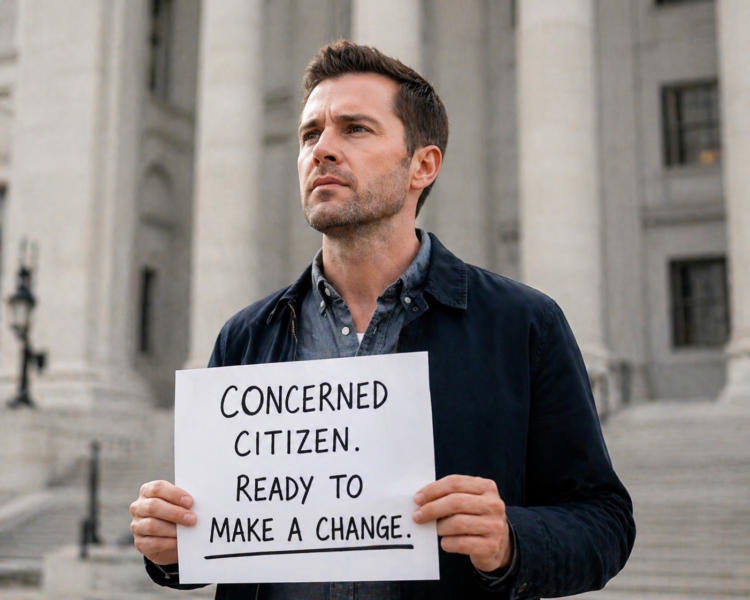
If you have ever felt like you are working tirelessly to improve your community but only seeing the same old “broken” results, you are not alone. Many motivated citizens feel like they are spinning their wheels in a cycle of endless rallies and partisan debates. At the Center for Self Governance, we teach a more comprehensive approach.
To truly keep our nation-state Republic functioning, we must move beyond the “either/or” mindset. It isn’t a choice between being a partisan advocate or a systematic student; rather, it is about understanding that both are essential tools in your civic toolkit.
In this lesson, we will explore why advocacy needs a foundation of systematic understanding and how you can balance both to become a true “Keeper of the Republic.”
Partisan Politics: The “Who” and the “What”
Partisan politics is likely what you see on the news every night. It is the world of elections, candidates, party platforms, and specific issues. This is an incredibly important part of our government’s design.
Think of partisan politics as the process of selecting the crew for a ship. You want to make sure the people on board share your values, understand the destination, and are committed to the mission. Advocacy, standing up for specific policies like property rights, education standards, or economic freedom, is the way we communicate the “What” we want those in control of government to focus on.
Without partisan politics, we wouldn’t have a process to choose our leaders or define our priorities. However, if you only focus on the crew (THEM), you might miss the fact that the ship and the engine (IT) are falling apart.
Systematic Politics: The “How” and the “Why”
This is where many well-meaning citizens run into trouble. They get the “right” people elected, but those people often struggle to make real changes once they are in office. Why? Because the machinery of government, the systems, jurisdictional boundaries, and administrative rules, is complex and often misunderstood even by those inside it.
Systematic politics is the study of how the government actually functions. It focuses on the “How.”
- How does a county commission actually pass a resolution?
- Where are the jurisdictional boundaries between a state and the federal government?
- How do bureaucratic systems evolve over time?
At CSG, we view government as a complex machine that requires ongoing maintenance. Systematic politics is the maintenance crew mindset. It isn’t about fighting the machine; it’s about understanding it so well that you can help troubleshoot and fix IT.

Maintaining the machinery of government requires the same precision as maintaining a jet engine.
The Analogy: Your Body and the Machine
To understand why we need both, let’s look at two simple analogies: the human body and the modern automobile.
Imagine you are feeling unwell. You can advocate for “health” all day long. You can hire the best doctor (the “partisan” choice). But if you don’t understand that the human body is a system of interconnected organs, you won’t be able to provide the doctor with the right information to troubleshoot the problem. You need to understand how the system works, how nutrition affects blood sugar, how exercise affects the heart, to maintain your health effectively.
The same applies to a car. If your engine is knocking, you can buy the most expensive high-octane fuel (advocacy) and hire a famous driver (elections). But if the oil hasn’t been changed and the pistons are worn, the car isn’t going to go anywhere. Advocacy without understanding the system is like trying to fix a car without knowing how an engine works.
Systematic politics provides the blueprints; partisan politics provides the direction.
Why Balance is Everything
When we lean too heavily on one side or the other, the results are often disappointing.
- Advocacy Without Systems: This leads to frustration. You might win an election or pass a single law, but the underlying “systemic” problems, like administrative overreach or boundary violations, eventually swallow those gains. You are treating symptoms rather than the disease.
- Systems Without Advocacy: This leads to stagnation. You might understand exactly how the gears turn, but if you don’t have a crew (leaders) or a destination (values), the machine just idles in place.
True self governance happens when a team of citizens understands the machinery of their government (federal down to school) and uses that knowledge to build collaborative relationships with their officials. Instead of an adversarial “us vs. them” approach, a systematic leader plays the long game and can walk into any meeting with partisans, elected officials, or public administrators and balance out the conversation with systematic audio frequencies.

Collaborative teams are more effective at restoring constitutional boundaries than isolated advocates.
The Pathway to Mastery: The School of Societal Self Governance
How do you begin learning the system? We have developed a structured, pedagogical path through our School of Societal Self Governance. This isn’t about “politicizing” your life; it’s about professionalizing your role for the “Office of Citizen.”
1. Apprentice Certification
This is your foundational level. To achieve Apprentice status, students complete 6 of 13 core classes. These include:
- Foundations in Self Governance: The “DNA” of the American system.
- Poli-Ticks: Learning to live a “politically disease-free life” by moving past labels.
- State Constitution Series: Understanding the specific “manual” for your state.
Please note: These foundational classes are designed to be taken online via Zoom, though we encourage attending live sessions when available for the benefit of group discussion (contact us to schedule).
2. Journeyman Certification
Once you have the basics, you move into the “how-to” of systematic politics. This level focuses on:
- Intro to Systematic Politics: Mapping the machinery.
- Competitive Systematic Politics: Learning how different systems interact and sometimes conflict.
- Advanced Competitive Systematic Politics: Real-world simulations where you apply your knowledge.
3. Professional Certification
This is the capstone of our training. At this level, you learn:
- Systematic Team Development: How to build a local “maintenance crew.”
- The Art of Political Chess: Understanding game theory and how to anticipate systemic moves.
- Systematic Messaging: Learning how to communicate in the “language” of the system to foster cooperation.

Leading with Purpose
By balancing partisan passion with systematic precision, you stop being a spectator and start being a leader. You move from “reacting” to “governing.”
When you understand jurisdictional boundaries, what we call the “eight-boundary republic” or Layer Cake Federalism, you can help your local officials stay within their proper lanes. This isn’t about confrontation; it’s about maintenance. It’s about ensuring that the school board is doing school board work, the county is doing county work, and the federal government is staying within its limited, constitutional bounds.
Join the Maintenance Crew
The Republic doesn’t run on autopilot. It requires a knowledgeable, disciplined, and systematic citizenry to keep the gears turning smoothly.
We invite you to start your journey today. Whether you are a business owner tired of bureaucratic hurdles or a parent concerned about the direction of your school district, the answer is the same: Learn the system. Lead with purpose. Govern your future.
Administrative Reminder: New students are encouraged to browse our Language of Liberty series for free introductory content. If you are ready to begin your Apprentice Certification, please check our upcoming class schedule and prepay to secure your seat. We look forward to seeing you in the classroom!


