Across the country, voters are being asked to decide questions that affect who may propose laws, how initiatives qualify, what level of voter approval is required, and whether legislatures or citizens control particular areas of public policy.
That is why this article uses the word trap.
The ballot itself is not illegitimate. The trap is assuming that voting is the entire system of citizen power.
A ballot measure can do more than establish a policy. It can change the rules governing how citizens will participate in policymaking in the future.
As of September 1, Ballotpedia reported 160 statewide ballot measures certified in 40 states for 2026. Forty-eight were initiated measures, while 111 were referred measures placed before voters by legislatures or other authorized institutions.
Does that distinction matter?
A citizen initiative and a legislative constitutional amendment may appear beside one another on the same ballot, but they enter the machinery of government through very different channels.
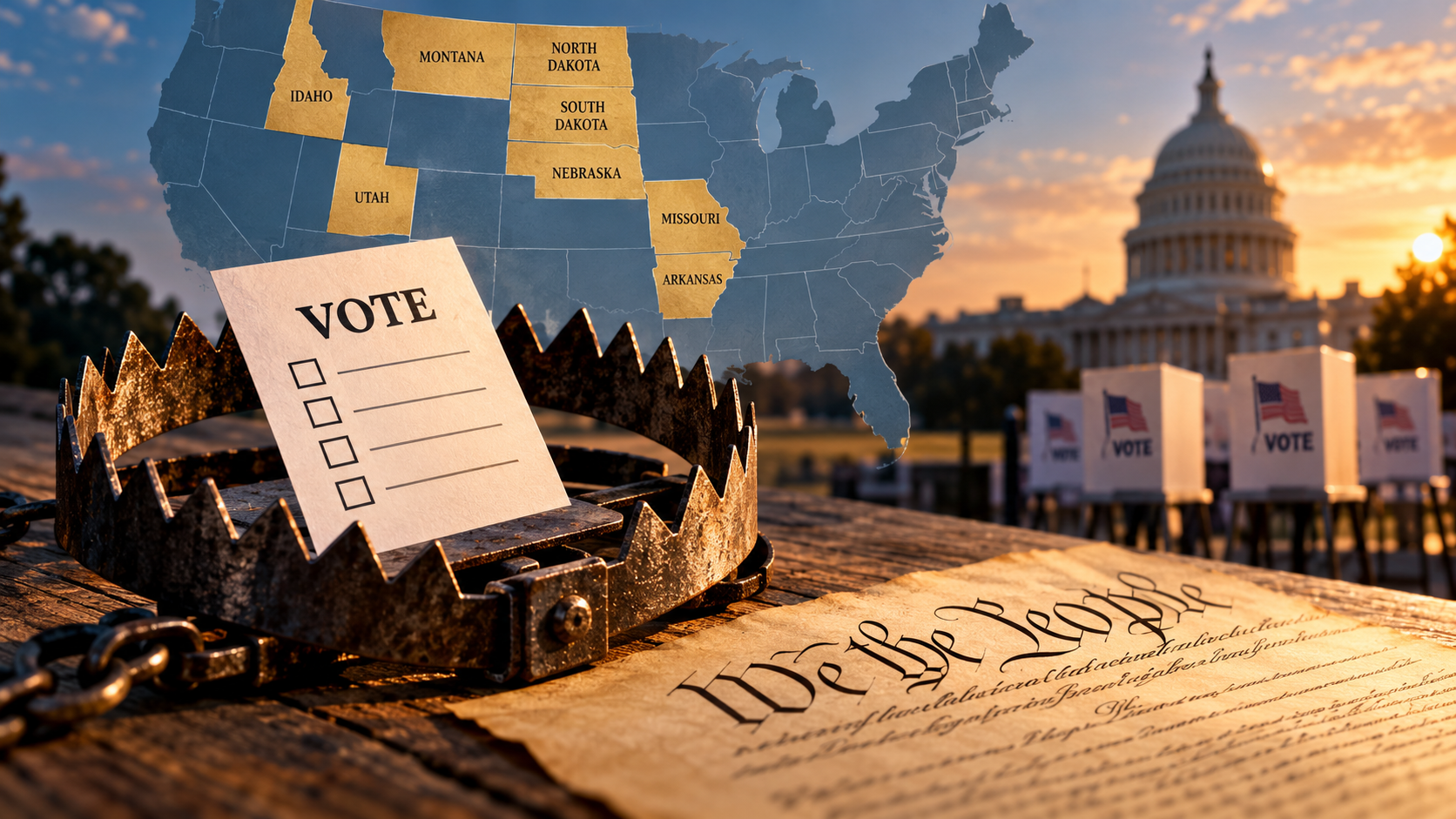
Several measures associated with eight states—Arkansas, Idaho, Missouri, Montana, Nebraska, North Dakota, South Dakota, and Utah—address the initiative and referendum process itself. Some seek to make citizen lawmaking more difficult. Others seek to protect initiative and referendum powers from legislative revision or restriction.
Understanding those differences requires looking beyond the campaign slogan and examining the mechanism being changed.
Part I: What Is Being Rewritten?
When people hear the phrase ballot restriction, they may think primarily about voter registration, identification requirements, or access to polling places.
But citizen power can also be altered through much less visible structural changes.
A ballot measure may change vote thresholds, signature requirements, geographic distribution rules, subject-matter limits, legislative amendment authority, or the governmental institution with final authority over a particular issue.
The important question is therefore not simply:
Do I support this ballot measure?
A more systematic question is:
What does this measure change about the relationship between citizens and government?
1. Changing the approval threshold
A simple-majority rule means that a proposal passes when more than half of the votes cast support it. A 60-percent requirement demands substantially broader support.
That may be defended as a way to encourage greater consensus. But structurally, it also means that a smaller minority can prevent a proposal supported by a statewide majority from becoming law.
The educational question is therefore not simply whether supermajority requirements are good or bad.
- What type of measure is subject to the higher threshold?
- Does it apply to statutes, constitutional amendments, taxes, or all initiatives?
- Who proposed the change?
- Does the new rule make future citizen action easier or harder?
The mechanism matters as much as the immediate political outcome.
2. Changing the subject-matter boundary
A second mechanism is jurisdiction over particular subjects.
Idaho’s HJR 4 provides an example. The proposal would reserve legalization decisions involving certain substances to the legislature.
For comparison, official source text is also available in South Dakota’s legislative record and Utah Senate Joint Resolution 2.
That does not eliminate the initiative process. Instead, it places a boundary around one category of public policy and says, in effect:
Citizens may exercise initiative power—but not here.
That is a different constitutional question from whether the underlying policy itself is wise. Citizens should therefore distinguish between two questions:
What policy do I prefer?
and
Who should possess the authority to make that policy?
Those are not the same question.
3. Changing geographic requirements
Missouri’s Amendment 4 illustrated another mechanism: geographic distribution.
Rather than asking only whether a statewide majority approved a citizen-initiated constitutional amendment, the proposal would have required approval in every congressional district.
That changes the mathematics of political power.
A geographically distributed requirement can encourage proposals to obtain support from different regions of a state. But it can also permit voters in a minority of districts to prevent a proposal supported by the statewide majority from taking effect.
Missouri voters rejected Amendment 4 during the August 4, 2026 primary.
That example also demonstrates an important rule for studying ballot politics:
Always distinguish between a proposal, a submitted petition, a certified measure, and a measure voters have already decided.
A headline may describe all of them as part of one political trend, but they are not at the same stage of the governmental process.
4. Changing legislative authority after voters act
The relationship between citizens and legislatures does not end when the votes are counted.
Citizen measures proposed in Arkansas, Missouri, Montana, and Nebraska approach the issue from another direction. They seek to make it more difficult for legislatures to weaken the initiative process or alter measures voters have already approved.
That raises another structural question:
When citizens enact a law directly, how much authority should the legislature retain to revise it afterward?
A ballot victory may appear to settle the question, but implementation still involves administration, funding, interpretation, regulation, amendment, enforcement, and judicial review.
In other words, Election Day is one point in a much larger governmental process.
Eight States Do Not Mean Eight Identical Proposals
The eight-state trend should therefore not be treated as though every state is pursuing the same reform. They are not.
Some proposals change vote thresholds. Some establish subject-matter boundaries. Some change geographic requirements. Some strengthen protections for citizen initiatives against later legislative action.
What connects them is not a single political agenda.
What connects them is the question of who possesses political authority and under what rules that authority may be exercised.
That is the real subject citizens should be studying.
Part II: How Should Citizens Analyze These Measures?
Recognizing that the rules are changing is only the beginning.
Citizens also need a method for determining what those changes actually do.
This is where systematic politics becomes useful.
Rather than reacting first to political advertising, partisan messaging, or even the title of a ballot measure, examine the mechanism.
Step 1: Identify where the measure came from
Determine whether the proposal is:
- citizen-initiated;
- legislatively referred;
- an automatic constitutional referral;
- a veto referendum;
- an advisory question.
Do not assume every question appearing on a ballot represents the same form of citizen action.
A measure initiated by citizens and a constitutional amendment referred by a legislature may look similar on the ballot while representing very different relationships of authority.
Step 2: Read the operative language
Do not stop with the ballot summary. Find the actual proposed constitutional or statutory text. Look specifically for changes involving:
- vote thresholds;
- signature requirements;
- geographic distribution;
- petition circulation periods;
- subject-matter restrictions;
- legislative amendment authority;
- judicial review;
- election administration.
Political campaigns tell voters what a proposal means.
The operative language tells citizens what the proposal does.
Step 3: Identify the government level being changed
Ask where the authority resides.
Does the proposal modify the state constitution, a state statute, county election administration, municipal government, the authority of a state agency, the power of the legislature, or the power of the courts?
Election systems operate through layers of government.
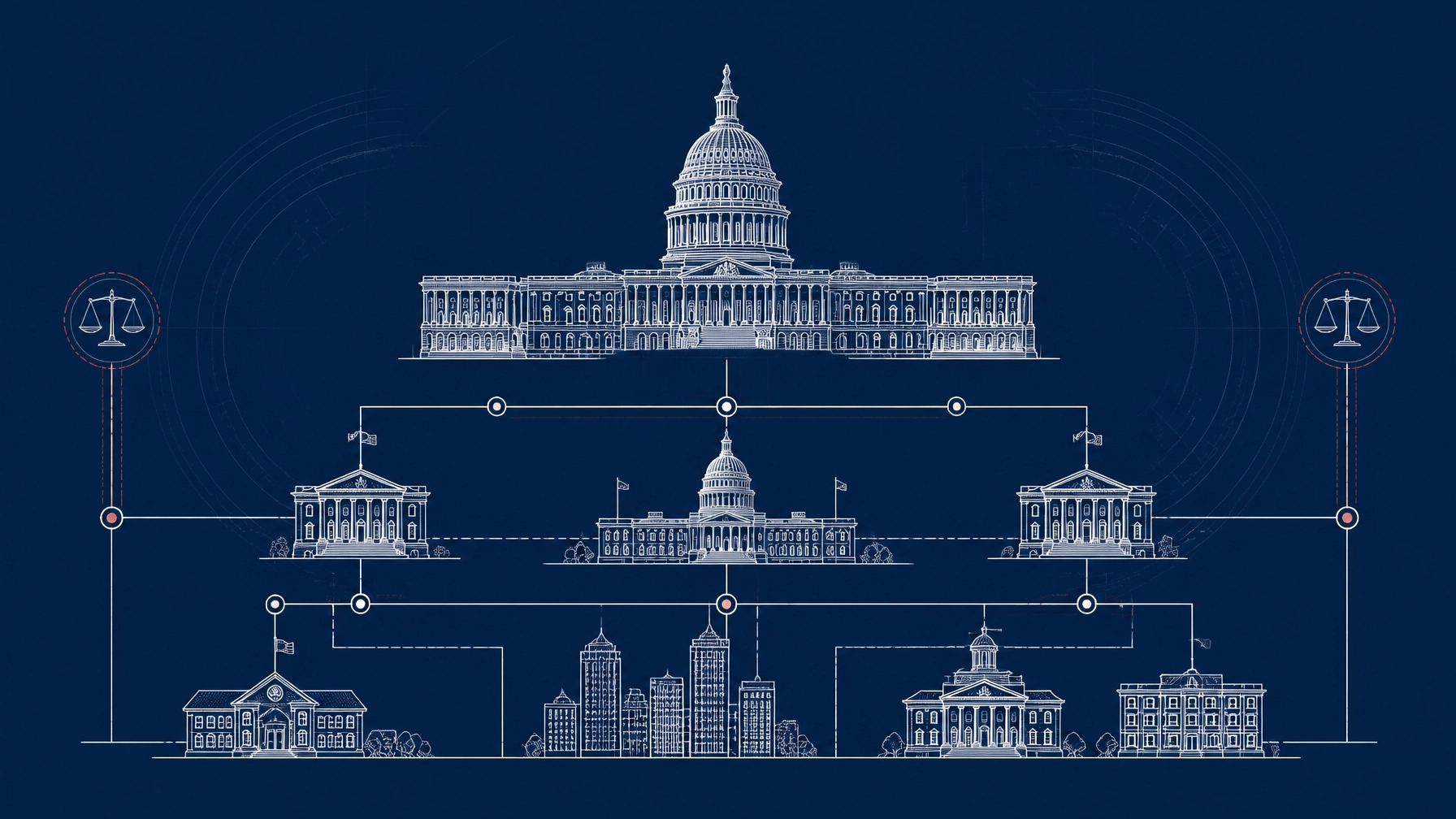
State constitutions may create initiative and referendum powers. Legislatures establish procedures and deadlines. Secretaries of state administer certification and filing requirements. County offices administer election processes. Courts review disputes. Voters exercise authority within that structure.
That is dual federalism and jurisdiction in practice.
A national headline can identify a trend.
It cannot tell you which governmental institution possesses the relevant authority in your state.
Step 4: Compare descriptions with primary sources
Begin with the official ballot language and your state’s election authorities.
Then compare the official explanation with independent resources such as the National Conference of State Legislatures and Ballotpedia.
The goal is not simply to find an explanation you agree with.
The goal is to identify:
- What changes?
- Who gains authority?
- Who loses authority?
- What happens next?
Step 5: Follow the measure beyond Election Day
If the proposal passes, ask:
- Who writes the implementing rules?
- Which office administers them?
- Can the legislature later amend the law?
- What public records will document implementation?
- Which court will hear a constitutional challenge?
Those questions move citizens from campaign participation into systematic engagement.
The Ballot Is a Door, Not the Entire System
Voting is a foundational civic responsibility.
But voting is not the complete mechanism of self governance.
The deeper responsibility is understanding how authority is created, distributed, limited, exercised, challenged, and renewed.
This is why the November 2026 ballot deserves closer attention.
The immediate political debate may concern substances, taxes, constitutional amendments, initiative petitions, geographic requirements, or legislative authority.
Beneath those individual questions is a more fundamental one:
What rules govern the citizen’s ability to exercise political power?
That question continues long after the ballot is counted.
Citizens who understand the machinery of government can follow authority through constitutions, legislatures, agencies, counties, courts, and elections. They can distinguish political messaging from governmental mechanism. And they can recognize when a proposal changes not simply a policy, but the rules by which future policies will be made.
That is the larger responsibility of the Keepers of the Republic: ordinary citizens who learn the system, build relationships across political differences, and participate purposefully in maintaining the institutions they have inherited.
The final sentence of the Declaration of Independence describes citizenship as a mutual pledge:
“And for the support of this Declaration, with a firm reliance on the protection of divine Providence, we mutually pledge to each other our Lives, our Fortunes and our sacred Honor.”
In the twenty-first century, renewing that pledge requires more than appearing at a polling place every few years. It requires understanding the system in which the ballot operates.
The path to self governance starts with learning the system.
Learn the System. Strengthen Your Role as a Citizen.
Voting is only one part of citizen power. The School of Societal Self Governance teaches citizens how to understand government structure, jurisdiction, constitutional authority, systematic politics, and the mechanisms that shape public policy before and after Election Day.
Explore the School of Societal Self Governance and learn how to move from reacting to politics to understanding the system.