If you have experienced selective enforcement, regulatory pressure, land-use conflict, bureaucratic delay, or another form of government weaponization, you already understand how difficult institutional overreach can be. A letter, hearing, permit decision, investigation, or administrative rule can affect your property, livelihood, family, and future.
The natural response is often immediate and personal: fight the decision, contact an official, file a complaint, or join a movement focused on the specific issue. Those actions may be necessary, but they are rarely sufficient by themselves.
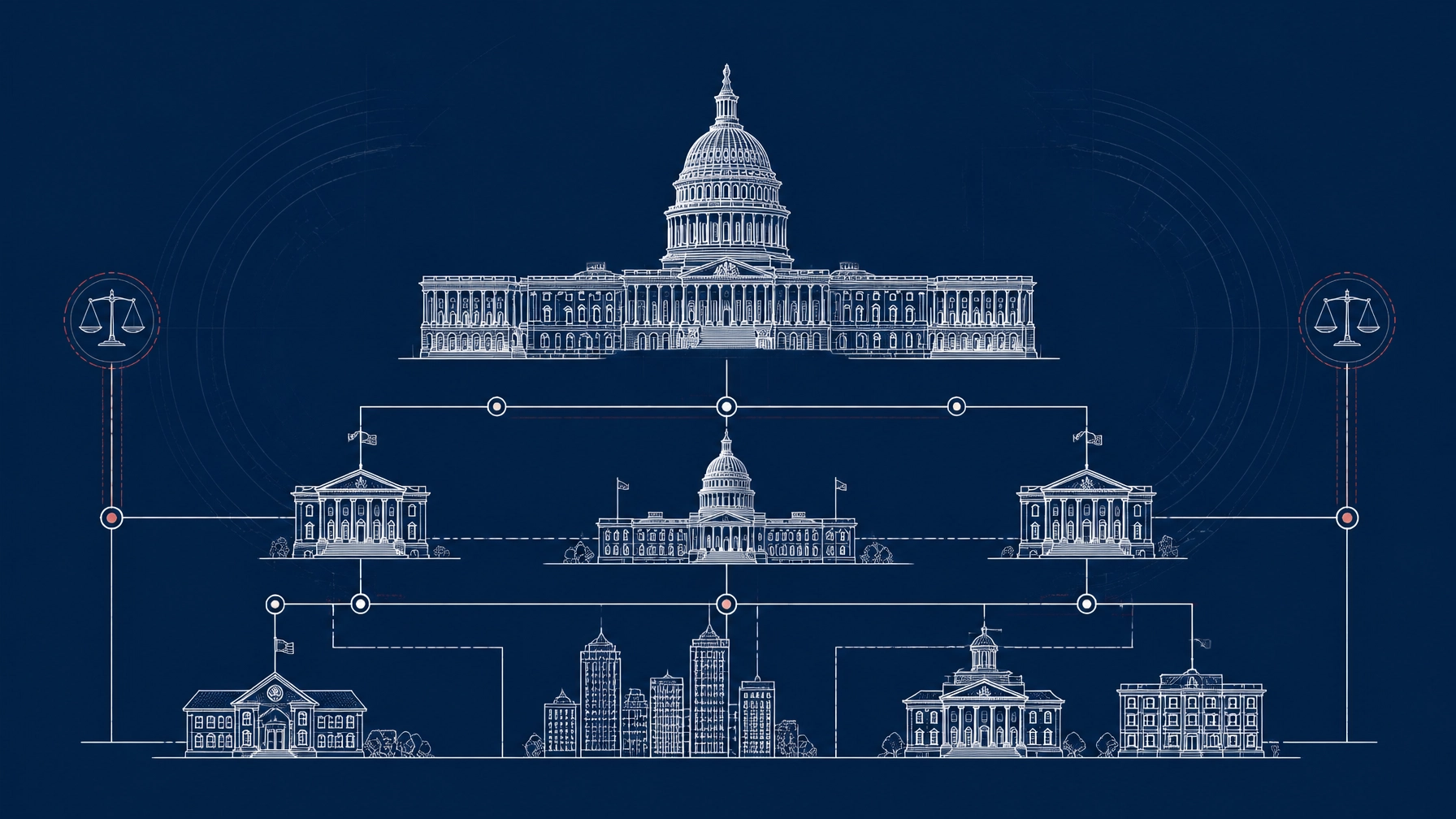
To navigate bureaucratic overreach effectively, you must learn the larger machinery of government. You must understand which institution possesses the controls, where that control stops, how jurisdictions overlap, and which relationships and procedures can produce lawful correction. This is the purpose of systematic politics.
What Institutional Overreach Looks Like
Institutional overreach occurs when a government body exercises authority beyond its constitutional, statutory, or procedural boundaries. It may involve:
- An agency acting beyond the authority granted by the legislature.
- An executive office performing a legislative function without proper authorization.
- A local body applying state or federal requirements outside its jurisdiction.
- A government process that bypasses notice, due process, public participation, or equal treatment.
- A regulation that conflicts with a constitutional right or exceeds the government’s delegated power.
The important question is not simply, “Is this policy good or bad?” A more foundational question is:
Who has the authority to act, what is the source of that authority, and what limits apply?
That question moves you from reaction to analysis.

Your Constitutions are the starting point, but reading the text is only the beginning. You must also study the structure that gives the text practical meaning: legislative processes, executive administration, judicial review, local government, public records, elections, intergovernmental relationships, and citizen participation.
Constitutional Boundaries and Dual Federalism
The American system was designed with multiple layers of government. Under dual federalism, the national government and the states operate within distinct spheres of authority, even though their activities may affect one another.
This arrangement creates boundaries and mechanisms for correction. Federal authority is limited to powers granted by the Constitution. States retain powers not delegated to the federal government. Local governments exercise authority through the state, according to state constitutions, statutes, charters, and other lawful arrangements.
Understanding these layers can clarify a bureaucratic dispute. For example:
- Identify the government level. Is the decision federal, state, county, city, or school-related?
- Locate the governing authority. Find the constitutional provision, statute, ordinance, rule, or policy being used.
- Map the jurisdiction. Determine which geographic area, subject matter, and people fall within that authority.
- Examine the process. Review notice, hearings, records, timelines, appeals, and decision-making requirements.
- Build relationships. Communicate with the relevant offices, legislators, legal professionals, neighbors, and community organizations.
- Choose the appropriate mechanism. Depending on the circumstances, that may include administrative review, public comment, legislative action, litigation, elections, or coalition-building.
This is not a shortcut. It is a disciplined method for replacing confusion with clarity.
Why Single-Issue Activism Often Stalls
Many citizens become involved in politics because of one urgent issue: zoning, water rights, education policy, taxation, licensing, land use, or a regulatory dispute. The issue matters. However, focusing only on the issue can conceal the structure producing the problem.
A citizen may win a temporary decision but remain vulnerable to the same institutional pattern later. A regulation may be withdrawn, only to be replaced by another mechanism. An official may change, while the underlying delegation of power remains intact.
Systematic politics asks you to study the entire system rather than one isolated event. It examines how power is created, assigned, funded, exercised, communicated, and corrected.
This broader approach also changes the way you engage with people. Instead of treating every disagreement as a personal conflict, learn to distinguish:
- The individual from the office.
- The office from the institution.
- The institution from the authority it has been given.
- The current decision from the larger system that produced it.
That distinction de-personalizes it. It helps you build working relationships with people inside and outside government while still maintaining a clear understanding of constitutional boundaries.
The Citizen as a Government Systems Mechanic
The Center for Self Governance compares government to a complex machine, a human body, or an airplane. Each analogy points to the same principle: a functioning system requires maintenance.
If an airplane develops a problem, a mechanic does not simply criticize the visible symptom. The mechanic checks the system, identifies the failed component, determines why it failed, and repairs it according to the design.
Citizens can approach government in the same way. A bureaucratic decision may be the visible symptom of a deeper problem involving:
- Unclear delegation.
- Conflicting authorities.
- A breakdown in legislative oversight.
- Administrative incentives.
- Weak communication between government levels.
- A failure to distinguish elected, appointed, and employed governing.
- A misunderstanding of state and local constitutional structures.
Your objective is not merely to express dissatisfaction. Learn the system. Locate the mechanism. Develop the relationships. Participate in the correction.

The School of Societal Self Governance Pathway
For students who want a structured education in these subjects, CSG offers the School of Societal Self Governance. The pathway is designed to move from foundational knowledge to applied leadership.
Apprentice Certification: Build the Foundation
Apprentice students complete six of thirteen foundational classes. The curriculum includes:
- Foundations in Self Governance
- History of Self Governance
- Systematic Politics: The Evolution of Cooperation
- Partisan Politics: The Evolution of Polarization
- Poli-Ticks: Living a Politically Disease-Free Life
- State constitution studies
- School, city, county, and regional government overviews
These courses introduce government structures, power, systems, control, jurisdictional boundaries, and the historical development of self-governance.
Journeyman Certification: Apply Systematic Politics
After completing the Apprentice requirements, students progress through three sequential training blocks:
- Introduction to Systematic Politics
- Competitive Systematic Politics
- Advanced Competitive Systematic Politics
Each block includes training exercises. The student learns to understand the self as the foundation for influencing others, view politics as a normal human activity, and examine government as a system for managing relationships.
The courses also explore the historical development of systematic politics, the evolution of federalism, and the structural changes that shaped modern government. Complete each block and its requirements before moving to the next.
Professional Certification: Develop Teams and Messaging
Professional students continue with:
- Systematic Team Development
- The Art of Political Chess: Game Theory
- The Art of Political Chess: Outside Gaming
- The Art of Political Chess: Inside Gaming
- Systematic Messaging
This capstone stage addresses team-building, strategy, communication, and systematic engagement. The emphasis is practical: develop a team that can study a local concern, understand its institutional setting, communicate clearly, and participate constructively over time.
Visit the School of Societal Self Governance course catalog or review current classes and events to identify your next step.
A Practical Starting Plan
If you are currently facing bureaucratic overreach, begin with these actions:
1. Document the facts
Create a chronological record. Preserve letters, emails, notices, applications, meeting agendas, recordings, and relevant policies. Separate what you know from what you believe.
2. Identify the jurisdiction
Write down the government level involved and the specific office making the decision. Then identify whether the authority comes from a constitution, statute, ordinance, rule, contract, or internal policy.
3. Read the controlling documents
Do not rely solely on summaries or social-media commentary. Review the applicable constitutional provisions, statutes, regulations, and procedural rules. Consult a qualified attorney when legal advice is necessary. Don’t have access to legal advice? Try AI with caution.
4. Build relationships
Introduce yourself to neighbors, community leaders, legislators, staff members, public employees, and others affected by the same structure. Listen carefully. Share organized information. Seek cooperation where interests overlap.
5. Select a lawful pathway
Consider public comment, records requests, administrative appeals, legislative education, judicial review, elections, or other appropriate mechanisms. Use the process that matches the authority and problem you have identified.
6. Keep learning
One successful outcome does not maintain a republic. Continue studying the machinery of government and help others develop the same capacity. Help your community develop a life-long continuing education pathway.

From Victim to Keeper of the Republic
Being harmed by institutional overreach can leave a citizen discouraged, isolated, or angry. Those responses are understandable. But they do not have to define your political life.
You can become more capable by learning how government is organized, how power moves between levels, and how constitutional boundaries are maintained. You can exchange isolated activism for systematic engagement. You can develop relationships that make cooperation possible. You can help form local leadership teams equipped to address problems before they become crises.
The path to self governance starts with learning the system.
The Declaration of Independence provides the enduring standard for legitimate government: authority must serve the rights and security of the people, and the people must remain capable of examining and improving the systems through which they govern themselves. That responsibility is not limited to elected officials or legal professionals. It belongs to every citizen willing to learn.
As the National Archives’ transcription of the Declaration of Independence records: “And for the support of this Declaration, with a firm reliance on the protection of divine Providence, we mutually pledge to each other our Lives, our Fortunes and our sacred Honor.”