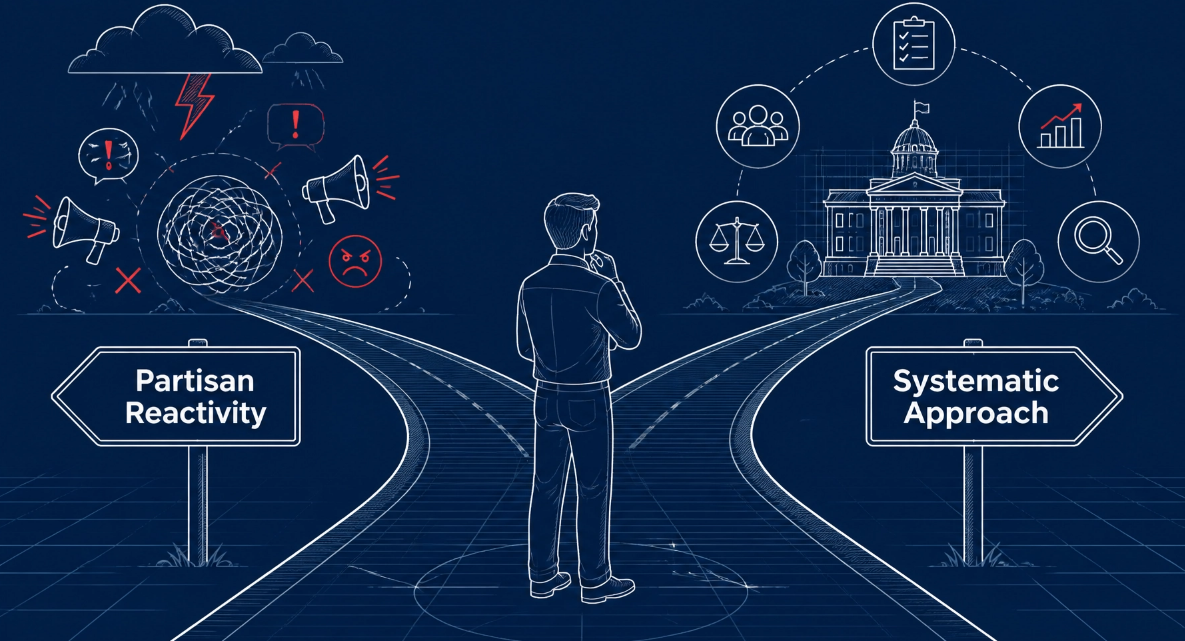
At the Center for Self Governance (CSG), we view the American Nation-State Republic not as a battlefield for ideological conquest, but as a sophisticated machinery of government that requires a diligent, informed maintenance crew. We refer to these dedicated individuals as “Keepers of the Republic.”
However, many well-intentioned citizens enter the political arena only to find themselves frustrated, exhausted, and ineffective. More often than not, this is because they are approaching the system with tools and mindsets that were never designed for governance. To truly Learn the System and Lead with Purpose, one must first identify and correct the fundamental errors that hinder effective civic engagement.
In this lesson, we will examine five common mistakes made in local politics and how you can transition toward a more formal, systematic approach.
Mistake 1: Treating Politics Like Partisan Warfare
The most prevalent mistake in modern civic life is the conflation of partisan politics with systematic politics. Partisan politics is an adversarial process focused on winning elections, securing a majority, and advancing a specific brand or narrative. While elections are a necessary mechanism, they are only a small part of the governing system.

When you treat every local issue as a zero-sum game between “us” and “them,” you inadvertently blind yourself to the actual machinery of power. Systematic politics, by contrast, focuses on the “how” rather than the “who.” It involves understanding ordinances, budgets, and administrative procedures that continue to run regardless of which party holds office.
Administrative Note: Our flagship course, Poli-Ticks: Living a Politically Disease-Free Life, is specifically designed to help students diagnose and remove partisan “parasites” from their civic strategy.
Mistake 2: Jumping on Single Issues without Context
Many citizens are moved to action by a specific grievance, a zoning change, a school board policy, or a new tax. While this passion is a valuable catalyst, “issue-based activism” is often reactive and short-lived.
If you only engage with your local government when a crisis arises, you are attempting to repair an airplane while it is mid-flight. A systematic leader understands that the “issue” is usually a symptom of a deeper procedural or jurisdictional misalignment. Rather than reacting to isolated sparks, we train our students to monitor the entire system, ensuring the “machinery” is functioning according to its original design.
Mistake 3: Ignoring Jurisdictional Boundaries
In our training, we emphasize the “Eight-Boundary Republic.” This is the foundational understanding that power is limited by specific jurisdictional lines, be they local, county, state, or federal.

A common error is directing your leverage at the wrong layer of the “cake.” For instance, demanding that a City Council solve a problem that falls under the jurisdiction of the County Commission (or vice versa) is a waste of citizen resources. Understanding where one authority ends and another begins is essential for any professional-level governance.
Mistake 4: The Lone Ranger Syndrome (Failing to Build Teams)
True self-governance is never a solo endeavor. Many motivated individuals attempt to “hold the line” by themselves, attending every meeting and writing every letter alone. This approach lead to rapid burnout and minimal impact.
Systematic engagement requires a team-oriented structure. Effective governance involves delegating roles: one student monitors the school board agenda, another tracks the county budget, and a third builds relationships with administrative staff. At CSG, we teach Systematic Team Development to ensure that your community has a sustainable, permanent maintenance crew.
Mistake 5: Misunderstanding Dual Federalism
Finally, many citizens fail to grasp the principle of Dual Federalism, the idea that the State and the Federal governments are both sovereign within their respective spheres. When we forget that the State is a partner in the American compact, rather than a mere subdivision of the Federal government, we lose our most potent leverage for protecting liberty.
Restoring the original design of the U.S. and state constitutions requires a rigorous study of “Layer Cake Federalism.” Without this foundation, efforts to restore self governance will remain superficial.
The Pathway to Mastery: Your 2026 Training Schedule
To help you avoid these pitfalls and move toward a professional standard of civic leadership, the Center for Self Governance has established a clear certification ladder within our School of Societal Self Governance.
1. Apprentice Certification
This is your foundational entry point. To earn your Apprentice status, students must complete 6 of our 13 foundational classes, including:
- Foundations in Self Governance
- History of Self Governance
- Systematic Politics: The Evolution of Cooperation
- State Constitution Series (tailored to your specific region)
2. Journeyman Certification
For those ready to move into competitive engagement, the Journeyman level introduces three sequential blocks:
- Intro to Systematic Politics
- Competitive Systematic Politics
- Advanced Competitive Systematic Politics (featuring live-action training exercises)
3. Professional Certification
Our capstone level for those committed to high-level leadership. This curriculum adds:
- The Art of Political Chess (utilizing game theory for inside/outside gaming)
- Systematic Messaging
- Advanced Team Development
Next Steps for the Student
If you are ready to stop reacting and start governing, we invite you to review our 2026 Course Catalog. Classes are available in-person, live-online, or via our self-paced Thinkific platform.
- Action Item: Please visit our events page to find an upcoming introductory session in your area or online.
- Preparation: Bring your curiosity and a willingness to look past partisan labels.
- Professionalism: Dress comfortably but prepared for a professional learning environment.
The path to self-governance starts with learning the system. We look forward to seeing you in the classroom and working alongside you as a fellow Keeper of the Republic.
Govern Your Future.