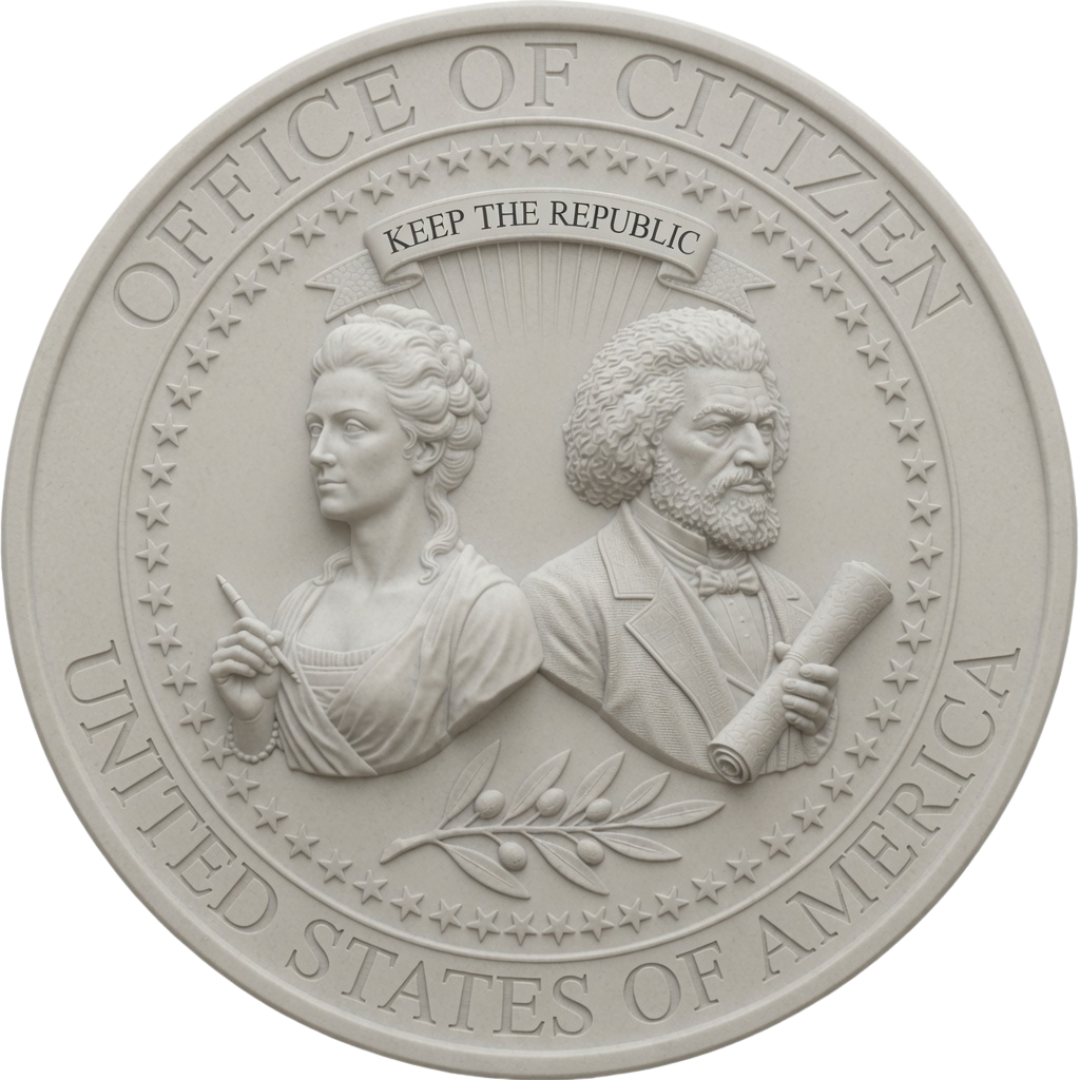
Welcome to a pivotal moment in our national journey. As we approach the historic milestone of 2026, the year of America’s semiquincentennial, it is essential to look beyond the celebrations and focus on the fundamental structure that makes such a legacy possible. At the Center for Self Governance (CSG), we view the American system not as a static relic of the past, but as a living, complex machine, one that requires an informed and disciplined maintenance crew to keep it running as designed.
In our curriculum, we often speak of the “Office of Citizen.” This is not a formal title granted by a government agency, but a foundational role inherent to the design of a self governing nation-state republic. Just as a pilot must understand the mechanics of an aircraft or a surgeon must master the human body, the citizen must master the machinery of government. To simply exist within the system is not enough; to govern your future, you must learn the system.
The Republic as a Machine: Why Maintenance Matters
Many citizens today feel like passengers on a ship they cannot steer. They see the “issues” of the day, the friction in local school boards, the complexities of land-use regulations, or the expansion of federal overreach, and they react with frustration. However, at CSG, we teach that these are not isolated events but symptoms of a system that has been neglected.

Consider the engine of a high-performance vehicle. If the oil is never changed, if the belts are never checked, and if the boundaries of the various mechanical systems are breached, the machine will eventually fail. The American Nation-State Republic is no different. It was designed with specific jurisdictional boundaries, what we call “Layer Cake Federalism”, that require constant monitoring.
When citizens step into the Office of Citizen, they transition from spectators to the maintenance crew. This role requires a shift in mindset: moving from partisan polarization to systematic politics. Instead of fighting over who gets to drive the machine, the maintenance crew focuses on ensuring the machine’s internal mechanisms, the constitutional and procedural boundaries, are functioning correctly. This is the essence of systematic engagement.
Mapping the Machinery: Jurisdictional Boundaries
A primary learning objective for any student of the School of Societal Self Governance is understanding the “eight-boundary republic.” In our constitutional design, power is not a single, monolithic block. It is distributed across multiple layers: school boards, city councils, county commissions, regional authorities, and state and federal levels.

In 2026, the focus for the Office of Citizen must be on boundary maintenance. Many of the frustrations we experience today occur because one layer of government has overstepped its boundary into another. When a federal agency dictates local land-use policy or a state legislature ignores the constitutional prerogatives of a county, the machine begins to grind.
Your task as a student is to become a specialist in these boundaries. This starts with our Foundations in Self Governance series, where we examine the specific authorities granted by your state constitution. Did you know that your local county commissioners hold significant jurisdictional leverage that can protect your community’s interests? Understanding these mechanisms is the first step toward building relationships with officials and ensuring that every level of government operates within its designed scope.
The Certification Pathway: From Apprentice to Professional
Self governance is a skill set that must be cultivated through rigor and practice. To assist you in this journey, CSG has developed a clear certification ladder. We believe that certificates of achievement are more than just paper; they represent a student’s commitment to the serious study of systematic politics.
- Apprentice Certification: This is the starting point. To achieve this, a student must complete 6 of our 13 foundational classes. These include History of Self Governance, which explores the evolution of cooperation from abolitionism to the present, and classes focused on state-specific constitutional frameworks.
- Journeyman Certification: This level introduces our Block One: Introduction to Systematic Politics. Here, the training becomes hands-on. Students participate in live exercises where they learn to analyze power structures and map the “art of political chess.”
- Professional Certification: The capstone of our training. This includes advanced courses in systematic messaging, team development, and competitive systematic politics. Graduates at this level are equipped to lead teams that maintain the Republic’s boundaries at the highest levels of local and state governance.
Note: For those unable to attend in-person sessions, we offer many of these courses through our live-online and self-paced platforms. Please ensure you have the necessary course materials, such as our training workbooks, before your session begins.
A Tactical Guide for the Office of Citizen in 2026
As you prepare for the year ahead, we recommend several practical steps to exercise the duties of your office effectively. Remember, our goal is not confrontation, but the restoration of the system through systematic engagement.
Step 1: Map Your Local System
Before you attend a meeting or speak with an official, you must understand the machinery. Who are the key decision-makers in your county (it may not be the county council members)? What are the specific procedural rules of your school board? Who are your city coucil members?
Step 2: Build Relationships Based on Knowledge
The most effective maintenance crew members are those who understand the manual better than anyone else. When you approach a local official, do so with an educational tone. Bring your copy of the state constitution or the relevant county ordinance. Position yourself as a partner in maintaining the system’s design. This “outside gaming” approach is often far more successful than adversarial tactics.
Step 3: Build and Fill Your Systematic Political Team
The Nation-State Republic was not designed to be maintained by isolated individuals. It requires a “maintenance crew”, a team of citizens who share a common language and systematic toolkit. We encourage you to find other students in your region who are pursuing certification. Together, you can divide the labor of monitoring various boards and commissions, ensuring nothing falls through the cracks.
Leading with Purpose in 2026
The year 2026 represents more than just a 250th birthday; it is a renewal of the “Keepers of the Republic” mindset. When Benjamin Franklin was asked what form of government the Constitutional Convention had produced, his famous reply was, “A republic, if you can keep it.”
“Keeping it” is the work of the maintenance crew. It is the work of the student who stays late to study a charter, the parent who learns the jurisdictional limits of a school district, and the community leader who refuses to be distracted by partisan rhetoric and instead focuses on the machinery of government.
We invite you to take the next step in your education. Whether you are a newcomer or a returning student, the path to self governance starts with learning the system. Enroll in a Foundations course today, and let us work together to ensure that our future remains in the hands of the governed.
Please prepay for your upcoming classes to ensure a smooth registration process. We anticipate a high level of engagement as we move toward 2027, and we look forward to seeing you in the classroom!